SafeGuardArmor.com
Tactical body armorsystems website. Including information on sizing and protection levels. Offering next day delivery on a high-end range of body armor products.
Site Archives
SafeGuardClothing.com
New & Used body armor website offering next day delivery on concealable, tactical and overt body armormodels. Includes an article database on absolutely everything related to body armor.
New Jersey has some of the strictest gun laws in the United States. Government’s overbearing ways are certainly present in this state. At a recent hearing where the public was invited to give opinions on upcoming gun control legislation – the government panel was not too happy with speaker James Kaleda.
James Kaleda is a Second Amendment activist who fights for our rights to bear arms. Please watch both video’s below.
The first shows Mr. Kaleda making his case against the proposed legislation and when he gets a little passionate about his beliefs he is immediately ejected. At the end of the video the crowd is seen clapping – which many anti-gunners have been saying shows a lack of support for Mr. Kaleda and what he was saying. The second video shows the truth.
This second video takes up where the last one ends – and the crowd becomes very agitated with not only the governments lack of interest in their Second Amendments rights, but the taking away of the speakers First Amendments rights. Several in the crowd speak up and are also told to leave. At one point someone suggest that the Pledge of Allegiance should be performed. I am not sure why…..other than maybe it was not done at the beginning of the proceedings or they wanted the government panel to hear the words of the Pledge. Either way – all those in attendance stood and said to – while all of the panel members did not – except for one who stood at the end..
Check it out:
This is just one of many examples that shows the government failing to respect the citizens WHICH THEY WORK FOR.
I just found out that a new edition of The Survivalist has been released – starting all new adventures for John Rourke (my childhood hero). The Survivalist #30 is now available on Amazon in paperback form. I have ordered my copy and cannot wait until it arrives.
Book #30 in THE SURVIVALIST series is finally out! THE INHERITORS OF EARTH has been a long and complicated journey for Bob Anderson and me; he as an avid reader of the series with lots of ideas concerning the continuing saga and me as the original co-creator now left in the position of deciding how Jerry would feel about the decisions made with our characters. This part of the series is based on a long term plan of action Jerry and I came up with quite some time ago so, Bob and I know where we’re going, it’s just all in the getting there.
This book is for those of you who have realized that perhaps some issues were not fully resolved in the series. This is also for those who read the last installment and were not satisfied that John Rourke seemed to be doomed to a new life, consumed with growing old and star gazing. THE INHERITORS OF EARTH is especially for all the loyal fans and friends who cared for the Rourke family and for the Aherns as well.
I’m an Engineer and really like solving problems. Especially, when there are lots of variables leading to a number of potential solutions. That allows me to put some of my personal preferences into the mix and develop what I believe is the best solution.
One of my sons asked me to put together a food plan for him out of our stores for an upcoming trip he is planning. The basic requirements are to feed two 30ish young men who are very active for 2 weeks. There were several parameters I was given to create the plan:
Water was not an issue
Prep time was not an issue
Variety was a minimal issue
Space was a significant issue
Weight was a significant issue
Stability and shelf life were significant issues (they didn’t want to take a cooler)
Nutritional value was an issue (eliminate the need for multi-vitamin if possible)
Durability of packaging was a significant issue (boys will be boys)
Basics such as salt, sugar, coffee, and spices were already accounted for in their camping gear
I started with a basic plan – feed an active adult male for 30 days (I added a little fluff for emergencies, spillage, and rounding errors). That gave me a starting point of 3,000 calories per day for 30 days or 90,000 calories.
My first thought was to supply them with several cases of MRE’s. At 1,200 calories each they would need 75 meals to total 90,000 calories. However, at approximately 1.5 pounds per meal this solution would have weighed about 110 pounds. Further, this solution didn’t provide much variety (24 different meals), didn’t address the durability issue, required the boys to consume partial meals (and store the remaining food) in order to meet the 3,000 calorie daily requirement, and supplied them with basics which they already had covered.
Delving further into our home storage I decided to use #10 cans of freeze dried foods. Since the foods are freeze dried, they are substantially lighter then MRE’s. The steel cans are much more durable than plastic packaging. The shelf life of the food was more than sufficient. The 6-pack boxes the cans came in were fairly space conscious. And, a wider variety of menus would be available (mix and match from various cans).
I decided that to ensure a reasonable variety I would only include one can of any particular food (even though I really wanted to get rid of 5 cans of banana slices my wife got on sale a few months back). Also, I set my goal on achieving the FDA daily serving recommendations for each food group – 2 of dairy, 3 of protein, 4 of fruits, 5 of vegetables, and 11 of grains. Further, the boys asked me to try to keep the calorie mix as follows: 15% protein, 55% grains, and 10% each for fruits, vegetables, and dairy. The percentage of calories from each food group was slightly more important to them than the servings per food group.
After a bit of trial and error (Excel spreadsheets are wonderful planning tools), I came up with the following food list:
9 grain cracked cereal
Cornmeal
Egg Noodle Pasta
Instant Brown Rice
Instant White Rice
Pearled Barley
Quick Oats
Quinoa
White Flour
Whole Wheat Flour
Chopped Onions
Chopped Spinach
Green Beans
Potato Chunks
Red & Green Bell Peppers
Apple Sauce
Pears
Pineapple Chunks
Sweet Cherry Halves
Chopped Chicken
Instant Black Beans
Whole Egg Powder
Instant Milk
Shredded Colby Cheese
Although there are a number of really good suppliers of freeze dried food products, all of the above was supplied by Thrive using their serving and calorie information. I included one can of each food product. This totaled 24 cans or four 6-pack boxes.
So, how did I do in meeting the requirements and solving the problem?
Here is the final analysis:
Total calories – 90,950 (101% of goal)
Protein – 14.6% of calories, 10.2 servings per day
Grain – 54.7% of calories, 12.7 servings per day
Fruits – 10.0% of calories, 5.9 servings per day
Vegetables – 9.9% of calories, 7.2 servings per day
Dairy – 10.8% of calories, 3.3 servings per day
Total weight – 57.21 pounds (about 60 pounds including packaging)
From my perspective, the protein and dairy items are very limited and would tend to get boring very quickly. The use of smaller pantry sized cans would have allowed for a greater variety, though at the expense of more space and weight.
Extrapolating this into information a typical prepper could use is fairly straightforward. If one person (active adult male in this example) needs 24 cans of food for one month (30 days), it follows that a one year supply of food would be approximately 288 cans. Depending on the actual calorie and nutrient content of the foods you select as well as your total calorie needs that number may be more or less, but it does provide a starting point.
The United States is falling apart. I am convinced daily that this country is falling apart and I believe history will show things are accelerating. What the end game will be I don’t know and what the time frame is – mystery as well. Bottom line is evil is growing stronger and it is not looking good.
I don’t want to jump all into politics – rather I will point out some of the wrongdoings of those in power have been and are doing. The recent events overtaking the headlines are just a few indications.
These are just a mild sampling of recent controversy occurring in Washington. The IRS targeting groups for political reasons. The Department of Justice accessing AP reporters personal information due to a White House leak. Let’s throw in the pathetic handling of the Benghazi situation where it is now proven that the American public was seriously misled and lied to. Ridiculous.
Our corrupt government continues to destroy this country. Between over-regulation, dramatic steps to increase gun control, economic decisions that contain a total absence of common sense, and the degradation of the moral being - this government is leading this country down a path that will be difficult to navigate back from.
If you are reading this site it probably does not take a whole lot of convincing to agree with what I am suggesting. This country…..this world, is drawing nearer to disaster. What it will look like is certainly up for debate. Whether it will happen or not – in my book, is a certainty.
What would our Founding Fathers think of what is happening to this country? No doubt tears would be shed and clenched fists made out of anger for the abuse of their hard work.
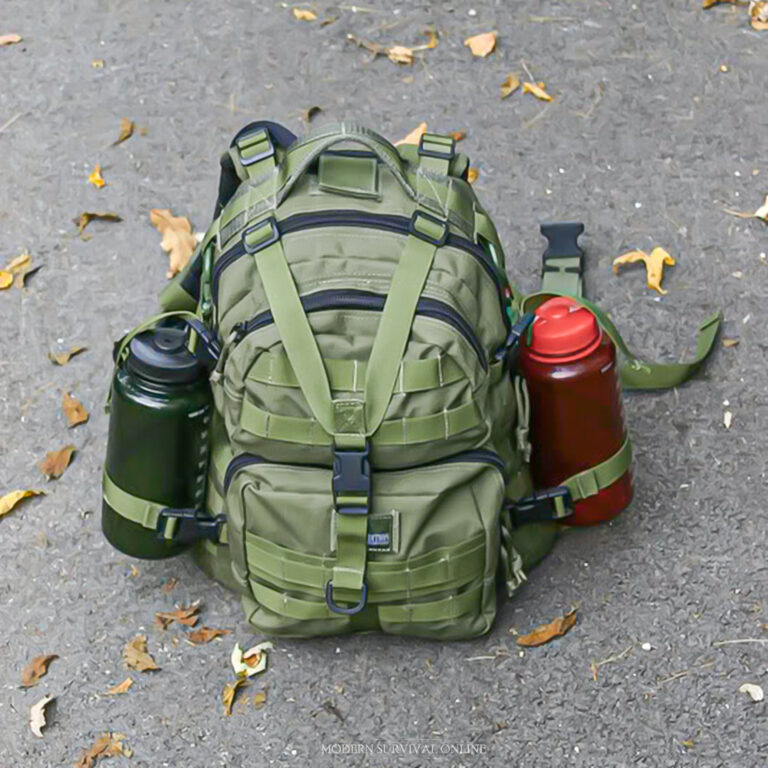
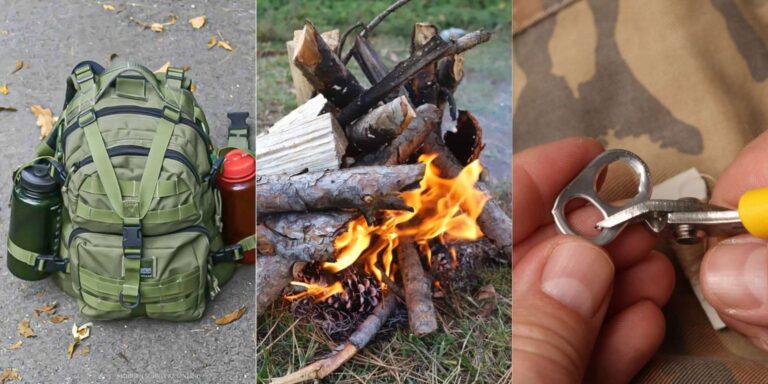
How long would it take for you to put a bag of emergency items together during a crisis? An hour? Maybe a couple of hours? Well, during an evacuation or other emergency situation, you may only have minutes to act fast. Will you be prepared to survive without emergency assistance for at least three days?
What is a Bug-Out-Bag?
A bug-out-bag is essential a 72-hour portable kit. It should contain the emergency items you’ll need after an evacuation. Since these kits are designed for 3-day survival, the main focus is all about evacuations. Bug-Out-Bags are very popular with Modern Survivalists.
The purpose of a bug-out-bag is to be prepared for survival during an evacuation. This is one of the concepts behind being a true survivalist. Because, as we know, it’s never about “if” a crisis will occur. It’s just a matter of “when” a disaster will strike.
10 Essentials for Your Bug-Out-Bag
Remember that a bug-out-bag is not about long-term survival. Your goal should be to focus on items needed for 3-day survival. Bug-Out-Bags should be as lightweight as possible, making them easy to quickly grab-and-go. Here are ten essentials that you must have in your bug-out-bag:
Water – Emergency preparedness experts recommend one gallon per day, per person. So, you need three gallons per person for drinking, washing and bathing for three days.
Food – It’s recommended that your food storage contain non-perishables, such as canned foods and dehydrated foods. You also want to include ready-to-eat non-perishables, such as freeze-dried foods.
Blankets – As a survivalist, you probably already have a bag prepared with a tent and sleeping bags. This is great! However, if you don’t have these items, be sure to pack thick blankets to keep you warm. They’ll also come in handy as padding if you have to sleep outside.
Coat – Many emergency are caused by natural disasters. Even during hot seasons, it’s best to have a thick coat with you. It can help protect you from winds, rain, even excessive heat from the sun.
Extra Clothing – Pack enough underwear and thick socks for three days. Also, make sure your survival shoes are heavy and strong enough to take harsh conditions, such as flooding. As far as other clothing items, there should be enough to keep you clean and clothed for three days.
Battery Operated Radio – You’ll need this, along with extra batteries to stay tuned for special alerts. Your local emergency rescue teams will broadcast emergency information such as evacuation locations, food storage locations, etc…
Battery Operated Flashlight – Most survivalists already have flashlights packed in their 72-hour kits. Check yours regularly to ensure that it works properly. Also, be sure to pack extra batteries.
Important Documents – List of important phone numbers, evacuation routes and evacuation center locations, maps, passports, birth certificates and copies of IDs.
Cash – Remember that when disasters strike, many things we take for granted every day stop working. Some of these things include ATM machines, credit card processing machines, phone lines, electricity, etc… If this happens, you’ll need hard cash to buy things you may want or need during your three days of survival.
10. First Aid Kit – Should contain basic first aid essentials. Be sure to include any special medications people in your home take. Also, include hand sanitizer, sun block and vitamins.
Author Bio
This article was prepared by Chett Wright of FoodInsurance.com. They are leaders in freeze dried foods. Ready to add products with a 25 year shelf life to your food storage? Click here to start your order now.
We know that in the aftermath of any major event like a hurricane or even some riot brought on by a political differences, society tends to fall apart. Once that happens, we know what comes next. This is what is known as the 3 5s. Check out how this law has played out in real life scenarios.
3-5 Hours Looting Happens
Within three to five hours of an incident, looting starts to happen as people begin to panic. People will do whatever it takes to get the supplies they need to survive or simply things that they want. There are some people who do not appreciate the looting and will go to great lengths to protect their property. A looter is often somebody who is hungry, dangerous and mean. Think back to Hurricane Katrina. People looted abandoned stores to get the food they felt they needed. With resources stretched so thin, there was nobody around to police the people
3-5 Days Store Shelves are Empty
Not everybody will loot. Some people will flood the stores to buy the things they need. Typically, a grocery store is only stocked with enough supplies to last 3 to 4 days. Shelves will be wiped out in the aftermath of any crisis. This was recently exhibited during the Hurricane Sandy situation. People were panicked over the prospect of the “Frankenstorm” and rushed to stock their pantries, resulting in empty store shelves. Local stores were wiped out of bread and other basic items, including batteries days before the storm even hit. Bread and batteries are both key elements of survival. People were doing what they could to prepare for the hours and days they would be without food and power. The mayor of New York City began distributing food 4 days after the storm hit.
3-5 Weeks City Folk Fan Out
After 3 to 5 weeks of coping with a disaster within the city limits, city dwellers will begin to fan out in search of necessities. One of the most devastating examples of this scenario is the Chernobyl disaster that happened in Russia in 1986. The city and surrounding areas were toxic with radiation. People who survived the blast left the city in the hopes of finding somewhere to live. Many were still very sick because of the radiation poisoning and were seeking medical attention. The survivors needed somewhere safe to live and to start over.
3-5 Months Groups Haphazardly Put Together Will Crumble
It is common for people to band together in groups after a major event. Groups are formed by people who have the same religious values, may be of the same race or from the same culture, or similar location. We saw this happen in Yugoslavia in the early 1990s after communism ended. Political leaders managed to destroy these groups with the use of fear mongering directed at opposing religious and cultural groups. This ended up leading to the “former Yugoslavia.”
3-5 Years Normalcy Returns
As humans, we are left with physical and emotional scars after a tragic event. This is true of a society that has encountered any major event as well. Although there is a strong chance society will get back to normal, it is very likely it will not be the same. There will be scars and if there have been any other similar traumas, that sense of normalcy will be delayed.
One way to understand how the new norm is different from the previous norm is to imagine a person’s life before and after a spouse died. It will take a few years, but eventually, the widower will begin to lead a normal life again, albeit a different normal than what life was like with the spouse.
Society is the same. After an event, people will strive to regain a sense of normalcy in their lives. It will probably never be the same. It is always a good idea to learn from events that have happened in an effort to avoid or be better prepared for the future.
First, a little background and base information. I am a retired US Army First Sergeant with over 30 years of military service. I have performed multiple jobs of my lengthy career, mainly in the Combat Arms. I was a Mortarman and Automatic Rifleman in the Airborne Infantry. I was a Unit Armorer, Supply Sergeant and Rifle Platoon Sergeant in the Mechanized Infantry and a Scout Platoon Sergeant and Cavalry First Sergeant in a Brigade Reconnaissance Troop. Those were all active duty positions. I was also a Military Policeman for 2 years in the US Army Reserves. I retired in late 2010.
My family began preparation for crisis, disaster, TEOTWAWKI in March 2011. I was convinced of pending calamity by a financial advisor’s video (Porter Stansberry). He spoke indepth on the potential for economic collapse, largely due to insurmountable national debt removing the US dollar as the World’s Reserve Currency. Our preparation efforts have been adversely impacted in the delay of the Veterans Administration processing my award for Service Connected Disability. I waited over a year for a decision, more than 18 months to get the back pay. But, I did finally get paid, which enabled me to purchase some beans, bullets and band-aids. Also, I collected and saved some things over 3 decades in the Army. I believe that this military equipment will be very valuable in any survival situation. I owned several guns before we began preparation for the pending tragedies. We have purchased multiple weapons specifically for WTSHTF. We have 4 members of our “Nuclear Family” as Jerry Ahern defines in his book “ Survive! The Disaster, Crisis and Emergency Handbook”. I have a wife and 2 teenaged sons. I wanted each family member to have both “stand off” and short range firing capabilities. I consider “stand off” to be a rifle or shotgun with slugs and short range to be a pistol.
This article was prepared with the presumed situation of a SHTF/WROL scenario that forces us to “Bug Out” away from our home. Ideally, we would be driving to a safer location. There are some situations where that would not be possible, ie: solar flare or EMP that shuts down electronics, roads closed due to natural disaster or just blocked by TSA, UN or Chinese troops! Anyway, I will carry a Ruger Mini-14 LE Model Tactical Rifle. It shoots 5.56mm (.223 Remington) bullets. I also have a Colt Gold Cup Series 70 M1911A1 Cal.45 Pistol on my web gear. I slide a Smith & Wesson Governor .45LC/.45ACP/.410GA (loaded with Winchester PDX1) in a leg holster for a short range weapon. I built my web gear using the vest type suspenders (as opposed to the old LC-1). I kept the 2 small arms ammunition cases on the pistol belt so to free up the ammo pockets on the vest for a hand held radio, GPS and some survival supplies. This set up holds a lensatic compass, 2 one quart canteens, a canteen cup, pistol holster, fixed blade knife and a small buttpack. The web gear is a complete survival kit containing all the basic necessities for shelter (poncho and emergency blanket), water storage / purification, first aid, sanitation items (toilet paper, baby wipes, soap), food procurement (fishing kit), plus several pocket knives and multi-tools (pliers and hammer types). The web gear holds about 200 rounds of 5.56mm ammo for the Mini-14 and 50 rounds for the M1911 pistol. The leg holster carries an extra box of 10 Winchester .410 GA (3 Defense Disks & 12 BBs) shot shells, plus a mixture of #4 shot (for snakes) and a few 1/5 ounce slugs.
My oldest son is assigned a Mossberg Model 930 SPX 12 gauge shotgun and a Smith & Wesson Model 19-5 .357 Magnum pistol. His web gear is very similar to my own. I attached a larger buttpack on this Load Bearing Equipment (LBE). It essentially hold the same survival items as my set up, with the addition of wire saw and a snack bag containing trail mix, Slim Jims, Beef Jerky, Nutri-bars and Jolt gum. He has the same 2 one quart canteens, canteen cup and 2 ammo pouches as me. With the addition of a shotgun bandoleer, he can carry 100 rounds of mixed 12 gauge ammo (slugs and “00” buckshot), plus about 80 rounds of .357 Magnum (6-gun, 4-speedloaders + a box).
I am giving my wife a Remington Model 870 20 Gauge Shotgun. She also has a Walther PK-380 handgun. She purchased one of those tactical vests that the SWAT teams use. We hooked the vest on a civilian fanny pack, the kind with the Nalgene water bottles on both sides of the zippered pouch. The vest / fanny pack combination is also a complete survival kit. Combining the sling on the shotgun and a cheek rest pocket on the buttstock, there is 25 rounds of mixed shotgun slugs and numbers 2 &3 Buckshot, plus 2, 4 & 6 Birdshot. She can carry about 40 rounds total for the shotgun and 74 pistol bullets (3 x 8 round magazines for the PK-380, plus a box of 50). True, the Remington 870 in .20 GA is not the best defensive weapon. But, it is a diverse tool for hunting food, if the situation warrants.
Since my youngest son is somewhat leery of rifles or shotguns with strong recoil, I have assigned him my Ruger 10/22 Rifle. As with the Remington 870, it would not be my first choice for security. I will point out that the BX-25 magazines holds 25 .22 LR bullets. I purchased several additional BX-25 magazines and bought an adapter that attaches three 10-shot rotary magazines together. In very short order, he could put out a hail of .22 LR rounds. I also gave him a Ruger 22/45 Pistol with 4 magazines. His web gear consists of the fanny pack with the 2 Nalgene water bottles.
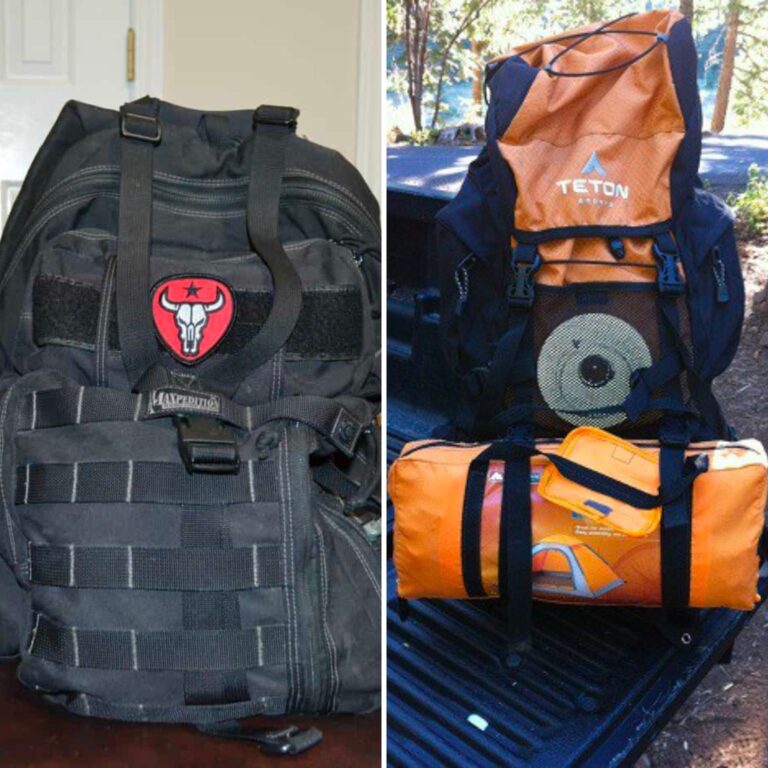
In addressing the rucksack / backpack assignments,(info deleted) I am still using my large frame rucksack that I had as a paratrooper in the early 1980’s. It may be more than I should be carrying with my current medical conditions, but I believe that I am mentally strong enough to push myself into bearing that weight. (info deleted) I have always subscribed to the theory that “It is better to have it and not need it, than to need it and not have it”. On the outside of the military ruck I attached an entrenching tool (small, folding shovel), a 24” machete / saw, a 2 quart collapsible canteen and a small hatchet. I won’t go over all the contents of the rucksack, but I will say that it holds similar provisions as the web gear survival kit, but in greater quantity or more elaborate spread. For example, the first aid kit in the ruck is larger than the buttpack. Where the buttpack contained a $2.50 Space Blanket, the rucksack has the military version of the $12.95 All Weather Blanket. I will credit John D. McCann’s book “Build the Perfect Survival Kit” for helping me choose the contents.
My wife and kids have smaller backpacks. They are using the Army Combat Uniform (ACU) medium rucksacks that Army National Guard Recruiters give out as enlistment perks. They are frameless packs with multiple, zipper-closed compartments. They hold complete survival necessities, including ponchos, poncho liners, folding saw or hatchet, mess, sewing, fishing, fire starting and first aid “kits”. There is also space for emergency blankets, SOL bivy, Mountain House or MRE entrees, Datrex Rations, toilet paper, baby wipes and a waterproof box holding insect repellant, sunscreen, Chapstick, water purification tablets, baby powder and a small tune of Curel hand cream.
Our packs are more “Survival Kits” than “Bug Out” Bags”. We each have a separate Bug Out Bag with clothing, more rations, personal hygiene items and a few manuals (Wilderness Survival, First Aid, Special Operations Medical Handbook, TEOTWAWKI (Rawles), Where There Is No Dr/Dentist (2 separate books) and SAS Survival Guide). I carry a versatile hand truck / cart in my SUV. The cart will hold our Bug Out Bags, a case of water, 1 case of MREs and a milk crate with auto items (larger First Aid Kit, tow rope, folding shovel, field shower, roll of garbage bags and camp toilet seat). This ingenious item is lightweight, but strong enough to hold 400 pounds. It can be set up as a cart on 4 wheels and be pushed/pulled down any hard ball road. Or, it can be stood up as a hand truck on 2 wheels and be dragged through the field. I considered purchasing a police ballistic riot shield to affix to the cart. But, that desire has not yet been fulfilled. We also have a collapsible hand truck for any last minute, additional items. Of course, we would only be using these hand trucks and carts if we were forced to walk to our “Bug Out Location”. Our intentions are to “Bug In” at our home. One quick note about storing weapons in my truck: I DO NOT carry all these weapons and bulk supply of ammunition around with me during routine use of the vehicle. In my mind, such practice would not be very reasonable. I do keep an AR-7 Air Force Survival Rifle, a Ruger 10/22 Takedown, a Rossi Circuit Judge .45LC/.410GA and the Savage Model 24J over/under .22 LR/.20 GA in the truck for most travel within the region. My wife and I both have concealed weapons permits in our home state. At any given time, I have the Colt .45 Auto or S&W Governor and she has the Walther PK-380 or Smith and Wesson .380 Bodyguard. We each purchased at least 4 extra magazines.
In closing, I feel compelled to state that we prefer a “Bug In” over “Bug Out” scenario, if we are to face any type of crisis or disaster situation. I am confident that we have covered the required security considerations with the mixture and breakdown of weapons on hand. The topography of the land surrounding our home allows us to engage potential threats with all 4 “Stand Off” weapons: Mini-14 and 10/22 Rifles, Mossberg and Remington Shotguns. I own a Bushmaster M4 Carbine, too. When I bring Son#2 “Up To Speed”, he can carry and fire it if he likes it more than the Ruger 10/22. The handgun calibers: .45 LC,.45 ACP, .357 MAG and .380 Auto are ample defense in protecting us in the odd event that robbers penetrate our perimeter.